Showing posts with label Deep Pretentious Post. Show all posts

Thursday, June 25, 2009

Peter David, Self-Identity and Hispanic Superheroes

So, there's a very lengthy interview with Peter David up at Comic Book Resources right now.* I am not terribly fond of Mr. David's current titles but that's more of a "personal taste" thing than a criticism (save his rather joyless She-Hulk run, but that's a blog post for another time). His stylistic tics kind of grate on me a bit but he's still a talented comic book veteran with plotting skills to spare.

More importantly, he is also the man who wrote the very first comic book I ever read - Spectacular Spider-Man #106:


I immediately identified with Peter Parker. We were both brown-haired, brown-eyed nerds who made bad jokes. I didn't understand a lot of the other stuff going on in the book (Starfox, for instance, puzzled the crap out of me) but I wanted to learn more about this cool guy with spider powers (which, of course, I was not and wanted to become). The funny thing was that one obvious difference between Peter Parker and I was never apparent to me until I got older.

Peter Parker was completely Caucasian while I was Mexican.

As a kid, I never thought about stuff like race. I was lucky enough to grow up with loving parents in Colorado, near Federal Boulevard, where Hispanic people often outnumbered non-Hispanics. It wasn't until I got much older and traveled in America, that I was even aware of encountering racism.

While I still generally don't make a big deal about it (stupid joke posts aside), I am Hispanic. Half-Mexican, a quarter Irish, a quarter English and just a touch Native American. The end result of my Mexican heritage being that I identify as such. While my skin tone waxes and wanes with the Sun, I'm generally light enough that most people can't place my heritage but still brown enough that I've gotten dirty looks in small towns and from small-minded people. I also later learned that, if I simplify my ethnicity to Irish-Mexican (as I often do, as that's how my Mother and Father identified, respectively), I even have my very own insulting ethnic joke, which I'm not going to repeat here.

Since nobody made a big deal about my race growing up, the lack of Hispanic superheroes didn't become an issue for me until I noticed people trying to give them to me. Richter from X-Force and the Living Lightning on West Coast Avengers appeared in my Marvel titles when I was just hitting my teen years.

Julio Esteban Richter was a mutant whose abilities allowed him to control seismic waves. He was a Mexican who watched his gunrunner father get killed at a young age. He usually ran around being angry and shouting things like "Madre De Dios!". He also tended to look like a back-up singer for Menudo.


In fairness, it was the '90s.

Living Lightning, a.k.a. Miguel Santos, was another Hispanic character whose Dad was killed while doing something ethically unsound. He was from East L.A. instead of Mexico and looked like this. In researching what happened to his ne'er-do-well Dad, he accidentally got the power to turn into living electricity. He showed up in 1990 in The West Coast Avengers, a team based in California. He also occasionally shouted "Madre De Dios!" and the like. A lot of the time, you couldn't tell his race because he was flying around as bright, yellow lightning.

Finally, the other character I took notice of was Angelo Espinoza - Skin. Skin was a mutant in the teen mutant book Generation X. His origin - well, I'll just quote the good folks at the Marvel Database here:

"Angelo Espinoza was born in the barrio in South Central Los Angeles. He became a gang member. His powers triggered during a drive-by shooting."

Yeah. Moving on . . . he was noticeably not brown, but gray, due to his mutant power being an excess of gray, strechable skin that he could manipulate. It also made him look strange and slightly deformed. Not nearly as cool a power as making Earthquakes or Lightning. He was, however, like Living Lightning, Catholic - just like I was growing up.


He was, surprisingly, my favorite Hispanic character growing up.**

While he still occasionally lapsed into "Madre De Dios!" territory, he was smart, cagey and good at holding his ground with what he had. He was also occasionally a smart-ass and occasionally full of self-loathing. In many ways, he reminded young, teenage me of myself or the me I was, rather than the me I wished I could be. That guy came a little later.

Back to my childhood and early teens - I still didn't completely identify with any of these Hispanic characters, even Skin (who was so uncomfortable in his own skin). I wasn't quite old enough to understand what "tokenism" meant but they all seemed a little too forced. Too many "Madre De Dios!"es and not enough normal moments. With the Hispanic race card being brought up in so many comics, I began to think about it. There was no singularly Hispanic character in superhero comics I read that I identified with . . . but amazingly enough, there were two Irish-Mexican superheroes I identified with to a great extent.

One was, I found out much later, Kyle Rayner, DC's newest, greenest Green Lantern.


His heritage wasn't really mentioned until much later into his career (turned out his Dad was a shady, Hispanic CIA Agent) and I just ended up being pleasantly surprised to find I had something in common with him. You know, other than the fact he was goofy, always learning and a bit googly-eyed around beautiful women. I saw way too much of myself in him to begin with so the race thing was just a pleasant surprise.

The second Irish-Mexican hero I loved, on the other hand, was "out" and proud. His heritage was right there in his name - Miguel O'Hara. KICK. ASS.

Just as he had reached me back when I was a kid, Peter David created another hero I loved who climbed up and over walls - Spider-Man 2099.


Miguel O'Hara was not from East L. A. or Mexico. He was born in a future New York City. Miguel O'Hara was a brilliant geneticist, a smart-ass and a cynic. He became Spider-Man 2099 when his plan to escape his evil Corporate Giant-type employers got sabotaged. His mother was Mexican, like my Mother was Mexican and his Father was Irish, like my Father was Irish. He was smart and while he did know Spanish, that didn't mean he had to scream "Madre De Dios!" every five minutes (he did yell "Shock!" a lot but that's a complaint of a different color).

I loved the hell out of this character and praised God for Peter David. He got me into comics and kept me in them, giving me a character I could identify with on a very personal level (and let's not even get into my rabid love of his Star Trek novels. Seriously, let's not. I don't want to completely embarrass myself here). If it weren't for Peter David, I would have never followed his work into the DCU and found all the excellent stories to be had there. Say what you like about Mr. David but he got me into comics and kept me there when I started to waver.

But the best part had nothing to do with Peter David. As I grew older, I noticed Hispanic characters evolving and appearing more organically in superhero comic books, ones not written by Peter David. Officer Renee Montoya began as a background character on Batman: The Animated Series and now? Now, after a few years of different writers gradually integrating her into Gotham City in the comics and telling her story, she's being written by the always fantastic Greg Rucka as The Question. How cool is that?

Nowadays, I'm happy to say that Hispanic teens growing up have some pretty great superhero role models. Outside of The Question, we've also got at least two great Hispanic teen heroes.


Victor Mancha, in Runaways is a half-Mexican, half-robot teen living in Malibu. He's more than a little nerdy, responsible and uptight but also calm and collected. Plus, wicked cool magnetic/electric powers. He also briefly dated Nico Minoru, the team's leader. And hey, sidebar - Nico is also a Japanese-American. She's dated Alex Wilder, an African-American, and Victor without anyone so much as saying "Boo" about it (at least to my knowledge). The fact that interracial dating is such a casual thing in this series is just one of the many, many reasons why I love Runaways and it's creator, Brian K. Vaughan. On a personal note, my first serious HS girlfriend was Korean, so I also find Victor's storylines accurate and encouraging for teens on a very personal level.

More notably, we have Jaime Reyes, the new Blue Beetle.


He is also a good, responsible young man but unlike Victor, he has a large, loving Mexican family (with a living, non-evil Father and everything) and lives in El Paso, Texas. Not only does he not lapse into Spanish for no reason, he actually got his own entire issue where he and his family spoke entirely in Spanish during their family reunion. Because they are all of Hispanic descent and living in Texas! Speaking as a guy who goes to his own Hispanic family's reunions, it tickled me to finally see Spanish being spoken in a comic in a way that was finally something other than a random signifier to say "Hey! I'm MEXICAN!". Incidentally, Jaime's best friends are of multiple ethnicities and he happens to be dating a teen sorceress named Traci 13 who happens to part-Asian. "Madre De Dios!" indeed.


Even if we still get to see him in Teen Titans and his own back-up series for him in Booster Gold, I miss his ongoing series like the dickens.

I don't often think about race in superhero comic books anymore, to be honest. I'm happy to say it fades into the background for me so long as it doesn't jar me out of the story by being offensive or off-key in some way. I had to stop and think about this topic to even realize that two of the characters in my favorite book currently on the stands, Secret Six, are Latin American (one Brazilian and the other from a fictional South American Island) - one of them being the team leader (and, incidentally, a lesbian).

I know there's still racism in comics, intentional or no, and I don't mean to diminish anyone who feels angry or nervous about how race is (or is not) progressing or being portrayed in today's superhero books. Still, I feel optimistic. Two African-American women are currently writing mainstream superhero comic books. Speaking purely for myself, I feel like we've come a long way in comic books and nobody is resting on their laurels. This progression feels natural, feels organic.

To quote an excerpt from an interview with John Rogers, the creator of the new Blue Beetle***:

"The job of a writer or artist is to reflect the world around you.
That's not an agenda," says Rogers, who gets frustrated by claims that
the comic exists only to fill some imagined quota. "Racism is
believing that other people of different backgrounds can't speak to you."

"My fondest wish," Rogers adds, "is that, 10, 15 years from now, a
Hispanic kid is going to take over writing 'Blue Beetle' -- or start
writing his own comics -- because he feels that the medium is
accessible to him."


I've read superhero comics all my adult life and I'm starting to really feel like we're getting beyond "tokenism" - this is just comic books reflecting real life. Multiculturalism is here and it's never going to go away. America is such a melting pot that even comic books can't hide their heads in the sand anymore if they want to reflect the real world.

And you know what?

Gracias a Dios por eso.


* There's also a much more humorous interview with Adam Warren to promote Empowered Vol. 5 up at CBR as well.

** Just as a brief aside - only two of these characters are still around.

Richter is now an occasionally suicidal and bisexual supporting player, coincidentally in Peter David's currently ongoing X-Factor series.

Living Lightning appeared briefly in the jokey Great Lakes Avengers mini-series to reveal he was gay and then scamper off. He currently has no current series of his own.

Skin? Skin got crucified on the X-Men's front lawn and died. His corpse was then used to illustrate that people were still so racist that they wouldn't bury mutants with humans. Jubilee and Husk got his corpse cremated and took it with them, which, um, yay?

Yeah. Blame Chuck Austen for that one.

Also, I remain unsure as to why so many modern-day Hispanic comic book characters are also gay. Go fig.


***
And also the excellent TV series Leverage - great show, go take a look.

Tuesday, April 7, 2009

Welcome to The LookOut, "YOUR NAME HERE" . . .


Aloha and bienvenidos to my humble blog about comics. I am your host, K. D. Bryan. I write, draw (badly) and blog in my spare time.

A quick primer for folks new to The LookOut (as all the cool kids call it*):

1.
I am a 31-year-old writer who writes when he is not earning a living through soul-deadening retail-related labor. I currently write fairly well-received short stories (found hither and yon) but I'm aspiring to write comics and the next Passable American Novel. I have something cooking in the very early stages with this talented gentleman, whose name is Shad Tischer. A hint of what's to come can be found more specifically here.

2.
I do semi-regular Haiku/Limerick Reviews of new comics. Most of them are favorable because if a book makes me unhappy, I just stop reading it. I'm a bad comic book fan, I know.

3. I have written a pretty well-liked list of 14 Comic Book Couples I Love, which has been unfinished for over a year now because I am a jerk. Luckily, since people have been asking what my "Scott and Jean" is, I will soon respond with "Scott and Emma" (although fellow comics blogger Kevin Church's answer of alcohol and more alcohol is also high on the list). This kooky list of my favorite comic book couples has generated the most Google hits for The LookOut - mostly relating to A) images of Spider-Man and Mary-Jane Watson-Parker, B) comics about people making love (I can only imagine - Illustrated Classics 11 - The Karma Sutra?), and C) Emma Frost naked.


. . . blogging can be a very fulfilling hobby. Just not when I check my search strings.


4.
I badly illustrate and write a webcomic based on my real life called K. D.'s Real Life. Yes, my creativity knows no bounds. If you would prefer to read biographical comics by a talented comic book artist instead, I recommend clicking here.

5.
Screechy fan entitlement drives me bonkers as a general rule but I get a lot of traffic whenever I dig down into my well of harsh criticism and drop the hammer down on titles or trends in the industry which greatly upset me. It is a conundrum, wrapped in a riddle, shipped in a enigma and stamped with a self-addressed mystery. In any case, I thank the always awesome ladies over at When Fangirls Attack and every other kind soul who's been nice enough to link here. You know who you are and I thank you.


6. My most consistent Google search engine term since the start of The LookOut has been "Emma Frost naked". Often, I hate the Internet. And yet, I continue to blog. So, clearly, I am full of self-loathing and confusion, which I mask with dry wit. Just like Emma Frost (or let's face it, Deadpool, given the level of my comedic stylings). Oh, the irony.

7. I am usually much more amusing and cheekily nerdtastic than this. Honest to Gosh. It's just been a long night full of writer's block, so I'm a tad cranky. If you feel like continuing to follow The LookOut, I shall prove to you why I should write comics or at the very least, entertain you with Bonus Video Content.


So, in short, The LookOut - Come for the incisive feminist critiques and comic book musings, stay for the Chimpanzee Riding on A Segway. Bam, bam-ba-ba-bam!


*Nobody actually calls it that. No matter how much I wish they would.

Friday, March 27, 2009

Flown The Coop


So, I usually like to keep things light and fluffy here at The LookOut and only talk about things that make me happy. That said, I just gotta let out a rant.

I hated the ending to Birds of Prey. Whether or not it was editorially mandated or not, it blew. I've always been of the school of "if you can't say anything nice, don't say anything at all" but some things just irk me until I can't keep quiet.

You see, I have this bad habit. I tend to analyze stories on their own merit. As a strict literary critic, it is a fine habit. As a bad deconstructionist and someone who doesn't always agree to the social contract that a comic book in a superhero universe is never, ever entirely it's own series - well, it drives me batshit nuts. Let's say I wrote a novel about two women who each have problems. One has a bad habit of dating cocky, blonde jerks (I'm not deliberately trashing Green Arrow here - that is one of the problems Dinah herself states at the beginning of the series). The other has issues stemming from an attack on her life that left her physically handicapped. One reaches out to the other to regain her feeling of power and ability to restore justice to the world. The other accepts her friendship and learns more about herself as a result. They both improve as people along the way and their circle of friends grow. Now, I would think the natural ending for such a story would be to have the outgoing character lead her introverted friend into a more comfortable space, filling her with confidence. The other half of that story would naturally dovetail into the more outgoing character becoming aware of her flaws and finding the confidence to live her life alone and only choosing to take a life partner if she feels that person is worthy.

That is not even remotely how this story ended.

Birds of Prey was a story, at it's core, about women making names for themselves and owning their own power. They acted with agency, competency and drive. They did so with joy in their hearts. And now, the series has just ended with Barbara Gordon dissolving her own team and leaving the care of a minor to someone else - all via a Dear John Letter. 127 issues and we get to see the main female lead end things, not in triumph, but awash in self-doubt, self-pity and just before running away.

To have a series devoted to such capable heroines - one that has lasted over 100 issues in a market that has not always been favorable to superheroines and even spawned a (mostly terrible) live action series - dissolved in a way that has Oracle berating herself and throwing in the towel, well, it's more than insulting. It's bad storytelling.

So why do I have such a bug up my nose, you might ask? Some back story for the uninitiated, first. Birds of Prey started with two characters - Barbara Gordon and Dinah Lance a.k.a. Oracle and Black Canary. Both were female characters who had supporting roles in the books of male superheroes. Black Canary was Green Arrow's girlfriend and Oracle was the Batfamily and the Justice League's hub of information. In BoP, each of these characters was given a place to shine and to grow. While Chuck Dixon was more than a bit guilty of making Black Canary a trifle flghty, he created a space where Barbara and Dinah could be the stars instead of the sidekicks.


In fairness, I didn't start reading Birds of Prey under Dixon. I read the trades, enjoyed them but felt like it was missing something. Cue Gail Simone. Her run, possibly because it was finally two female characters actually being written by a woman, felt alive, interesting and authentic in ways Dixon's did not. There's a quote I quite like from Gail Simone, the writer whom I took to following the book for because I love her work -

"Birds of Prey got a reputation for scraping the barnacles off of a lot of characters, which I find very flattering. [...] One amusing thing is, we managed to do fifty issues without a single serious romantic plot of any seriousness. I'm actually pretty tickled about that, as that seems to be the first thing writers think of when writing women - "Who is she in love with?" The Birds can stand on their own in that regard."

Simone wrote Dinah as fighting her way into being the equal of Lady Shiva - one of the DCU's greatest martial artists, on par with Batman. She wrote her as having enough control over her sonic abilities to shatter a billiard ball in a person's fist without breaking their fingers. She wrote Barbara as a woman who could always fend for herself but surrounded herself with friends who mattered. Who, in taking in Lady Blackhawk, Huntress and Misfit, made a team a family. More than anything, this became a book where women supported each other and superheroines had a place to shine. Just check out this exchange between Canary and Huntress to see how tender Simone's run could get.


And Oracle, quite simply, kicked ass. This was an Oracle who'd carved out a niche in the DCU and shined as one of it's stars. The Birds of Prey became a team as important in their own right as the Justice League or Teen Titans. When Simone had a villainess appear to forcibly take over Oracle's team - to remove her agency - Oracle called in everyone who owed her a favor and it looked a little like this:


Gives me shivers every time I see it.

And now? Now, Dinah is the "co-star" of Green Arrow/Black Canary. She's married to Green Arrow, the man who got her hand in marriage by faking her adopted daughter's death and lying to her about it. The man who, in a recent issue of Green Arrow/Black Canary, demonstrated his respect for her by shocking her unconscious before going to do things himself.


Not to mention the fun plot wherein Dinah was so sloppy that she needed help defeating someone hand to hand, then stopped him with a sonic cry that deafened an innocent bystander. Yeah, that's just terrific respect for the character and her abilities.

On the Oracle side of things, we now get an Oracle mini-series to follow up the underwhelming ending to Birds of Prey. I won't even start on how obnoxious it is for Oracle to have abandoned Misfit, a girl clearly in need of supervision and care, because that would lead me down Cassandra Cain Drive to Rantypants Road. Let's just say that the former team leader and heart of the Birds of Prey now toils alone in a crappy apartment with the promise of a cure for her paralysis dangled in front of her (scroll down here for several far more salient reviews of Oracle: The Cure).


A lot of people have been saying that this story will lead to Barbara Gordon becoming Batgirl again, which I'm sorry, does not strike me as a step up. As Oracle, she was a team leader, a woman who called the shots. I don't think this character needs to reclaim anything by becoming a girl again.

Here's a fun question - exactly how many appearances did Green Arrow have in Birds of Prey? Ever? And how many times did Batman ever appear? I ask because, after reading 50-plus issues of Simone's run, I don't remember Green Arrow doing much of fuck-all. And I remember the one time Batman appeared, he got told off by everyone for being a prick and then subsequently thanked for not being a prick once he stopped trying to run the Birds of Prey himself.


Please understand that, for somebody who read Birds of Prey - and only Birds of Prey - having Black Canary shipped off to be married to Green Arrow felt like a crazy random plot twist. It was like reading fifty issues of Batman only to have Alfred say "Hey, I'm in love with Martha Kent and we're moving to space now, KTHNXBYE." Yes, I get it. I'm being unfair by, heaven forfend, judging the series on it's own merits. There's history. There's continuity! They wanted to respect the longterm, hardcore DC fans who've followed the Black Canary/Green Arrow relationship for decades. The problem is not that they wanted to do that. It's how they did it and how they're continuing to do it. If they did it in a way that was organic and spun out the story in Birds of Prey naturally, I'd be all for it. If they were writing Black Canary at the same level Simone did, I'd be happy as a clam. They didn't and they aren't. If they're going to write a book about Black Canary and Green Arrow as a married couple, it should be a book that treats them as equal partners, not one constantly having to be incompetent to make the other look good. Hell, I still think that if they wanted Green Arrow to win Black Canary back, they should have had him do it in her title as well as his. That's called a partnership and I think it was something that the character of Black Canary, strengthened by Simone as she was, had earned.

Hey, I know I'm talking like a crazy entitled fan here and I apologize. These are not my characters and I have no real right to demand they be written any which way. The thing is, I give out my Simone trades of BoP to non-comic book readers to encourage them to enjoy comic books. I see BoP trades in the teen sections of my local library, where young girls are reading them. It's a story of how Oracle took back her power and showed Canary just how much she could take back hers and seriously? That's awesome. So when I see this story ending with one of them being married off to a guy who's acting like a jerk and the other one left full of self-doubt and confusion, it feels like a betrayal. Not just a betrayal of the characters' own arcs but moreover of the principles on which the book itself was formed. And that makes me angry and more than a little sad.


Anyways, I think I've ranted enough for one night. Here's hoping that both characters end up more awesome than they are currently being portrayed. And failing that, let's hope that Lady Blackhawk, Huntress and all the good work previous writers have done on the title doesn't get forgotten, ignored or, heaven help us, fridged away*.

*Seriously, guys, I will go all Chris Crocker if anything happens to Lady BlackHawk or Huntress. Of course, to be brutally honest, I wouldn't mind it too terribly if something bad happened to Misfit. Sorry.

Friday, October 24, 2008

You're the best around

So, many, many moons ago, the always charming SallyP tagged me with a meme - what's the best comics blog post I've ever read?

It's a toughie. I'm tempted to go with the easy answers and good times. Pointing at smart blogs, linkblogs and folks in the know are tempting as well, but no. Of course, there's always turning towards drama but as they say on the streets, I save the drama for my mama.

I can't really choose just one. I've read blog posts that are thoughtful and inspiring, sweet and charming and ones that just plain confuse and frighten me.

So, if I have to chose just one blog post to say was my favorite (praying I don't snub any of you all whom I read regularly), I'd have to give the nod to this post. The auction may have fallen apart (thanks, DC) but this - this is what comics blogging is all about at it's finest.

Of course, funny memes and pictures of superheroes as hobos are also excellent uses of comics blogging. ;)

Tuesday, August 19, 2008

Late to the party but still worth talking about

I'm probably the last person posting this but there's some serious thoughts on a big problem within ComicCon here. Well worth a read. I seriously hope it spawns an online petition to add something to the ComicCon bylaws to respond to sexual harassment.

The actions described upset me on a variety of levels. I'm furious for the women who were harassed and I'm also incensed by the way these "men" seemed to think that their behavior is somehow acceptable. Is it naive of me to say that I'd hoped - nay, prayed - that we were beyond this? That men at a comic book convention were cool enough and God, grown-up enough to not act like disgusting, entitled cavemen? Any woman who enjoys comics and participates in the comic book industry shouldn't have to deal with a swarm of jackasses living up to the "Immature, Misogynstic Mouthbreather" cliche. A part of me wants to go off on a multitude of angry tangents but I'll rein myself in as much as I can.

The worst part is that I make a genuine effort to think the best of comic book fans (which is, admittedly, not always an easy thing to do sometimes). I try to focus exclusively on the positive parts of this industry that make me happy and show all the good we're capable of achieving. I want to believe that the assholes described in this post are the exception and not the rule. I want to believe that, as a whole, comic book fans of any gender are fun, pleasant and generally awesome people. Call me naive, but I like to think that comics - especially the superhero comics SDCC tends to focus on - are mostly about inspiring people to have a sense of wonder, to implore people to hope and, most of all, to treat those who are different from you a little nicer. If these male comic book fans can't understand the most basic precept of treating another human being with the exact same dignity they'd expect from a total stranger after reading tale after tale where people fight for justice and equality, I have to wonder - what questions should we be asking? Has the superhero comic book industry failed to instill a sense of real, potent equality between the sexes in it's fans? Or does the only real failure fall at the feet of these "men" who just aren't paying attention to the basic laws of human decency?

I'm sorry if this is rant-y and possibly over the top but I tend to take this sort of thing personally. Every asshat who behaves like this at a comic book convention tars the reputation of every other genuinely decent guy at the Con. If I'm going to be attending SDCC next year, I don't think it's asking too much for a standard of behavior, ethics and respect in my fellow attendees. Jesus Christ, this depresses me.

Sunday, February 17, 2008

14 Comic Book Couples I Love - Emma Frost & Scott Summers, Part 1.

Consider my promise to you, my long-suffering readers, at least partly fulfilled! Here's part one of my Mega-Sized Emma & Scott post . . .

Part 1 - Little Boy Lost and Found - The Life of Scott Summers


Most people don't think about this fact but Cyclops has been a part of the Marvel Universe for as long as Spider-Man, the Hulk or the Fantastic Four. He's got a lot of history behind him but for the most part - having shown up in 1963, for God's sake - but people don't give a crap about him. He's never been as big, flashy or noticeable as the other characters in Marvel's bullpen. As part of the X-Men's ensemble, he often gets lost in the shuffle. Hell, even I was guilty of thinking he was just a boring, stoically heroic piece of cardboard . . . until I started to look closer. The reason I looked closer? His relationship with Emma Frost, naturally.

To really understand why I like their relationship so much, I think it's important that we take a look at the parts of Scott Summers that make him just as interesting and fully realized as Peter Parker or Bruce Banner - the incredibly sad, messy, ugly parts. I may play fast and loose her and I'm not anywhere near a total expert in continuity, so if I get something wrong, please feel free to correct me.

If you stop and think about it, Scott's past is way more tragic and emo than Peter "Boo hoo, my Uncle died" Parker. This is a boy who grew up with acres of emotional pain and abandonment issues. His parents shove him and his younger brother Alex out of a plane to save them before they both "die" (in actuality, Scott's parents are kidnapped and put into slavery by aliens but that's not relevant at the moment. Ah, comics). As the two fall, Scott manages to get a severe head injury that leaves him comatose. After he wakes up from a year-long coma, he finds out A) he's an orphan, B) his brother's already been adopted elsewhere. Try to imagine just how lonely and lost he must feel.

And on top of all of that, he's got these destructive eye blasts that can only be contained by ruby quartz. Or does he? In Joss Whedon's brilliant Astonishing X-Men #14, an addled Emma Frost systematically rips apart all her teammates from the inside-out. She begins most expertly with Cyclops, whose bed she shares. Because she still loves Scott, she leads him to a realization so painful it leaves him briefly comatose and powerless. Emma shows him just one terrible memory he's put away and forgotten. A memory of a decision that changed his life forever.


Earlier in their discussion, Emma says "Control. First to last, that's the thing." in regards to Scott's cornerstone." This memory - the story of a boy who decides his powers are just as out of his control as the rest of his life - is just the cornerstone upon which all his other neuroses are built.

Oh, and did I mention he's in an orphanage run by a guy named Mister Sinister who proceeds to experiment on his mind and his body? He lives there for quite some time, until he wisely runs away, more alone than ever before. He leaves with mental blocks put there by Sinister and one he's installed himself.

So after all this loss and heartbreak, what happens? He finally gets adopted . . . by a C-list Supervillain who beats him if he refuses to use his abilities to commit crimes with him. A violent man Scott eventually kills to save the lives of himself and his new "adopted father," the emotionally distant Professor X. A man named Jack O'Diamonds . . . whose ability was to turn into living diamond.


Yeah, let's let that one sink in for a little while, shall we? Morrison, you magnificent bastard.

Ah, but now Professor X takes him in and suddenly all is right with the world, right? Not so much. Think about it - Scott Summers is taken out of a relationship where he is beaten if he does "wrong" and placed in one where he delivers the beatings if he does right. A relationship where his new, aloof father figure only gives him praise and encouragement if he masters his abilities to hurt and destroy - even if it is for some lofty, unrealized goal of peace and equality. Not all that healthy, when you stop and think about it, is it?

Scott is a man whose very adolescent existence were defined by two things - using his powers and demanding father figures. The lesson he gets hammered into his head over and over by the Professor and the nature of his powers is a simple one that is damaging when taken to extremes - "Control". Control the situation, and above all else, control yourself and your powers. People will get hurt otherwise. As a result, the emotional straitjacket that makes Scott into a bland, controlling leader is born - a straitjacket Scott both hates and secretly loves like a warm, comfy blanket.


"Control. First to last, that's the thing."

A recent flashback shown in X-Men: Legacy has even gone so far as to hint that Xavier used his telepathy to enhance these feelings and need to be a perfect, controlling leader rather than to destroy them. His disowning the Professor makes more and more sense the more you think about it.

Of course, his new life with the X-Men is not all bad. He gets to feel in control - blissful, beautiful control. He also meets new friends who tease him to get him out of his shell when he's not busy leading them into life and death battles. Best of all, he meets a pretty girl named Jean who likes him. Kind of a lot. After an adorkable courtship, the two teens develop a relationship and they both fall in love for the first time.

Now, you might think I dislike Scott and Jean, given the title of this post. The funny thing is that I like Scott and Jean. They make an adorable teen couple. They're supportive, sweet and everything an adorkable first love should be. Scott and Phoenix, on the other hand? Not so much of a fan.

Let's just try to look at this from an everyday perspective. You've got a girlfriend who you love and who loves you back and that's fine and dandy. She then gets possessed by a space alien pretending to be her, which is not so good. She's also now so powerful that she can EAT THE SUN. After she creates a permanent, all-encompassing psychic link with you, your love becomes one of the only things keeping her centered, sane and, oh yeah, NOT EATING THE SUN. Putting aside the notion of how a total telepathic link between you and your lover would actually be more creepy than intimate in practice, the whole thing just seems hinky. Scott Summers is left with the one aspect of his life he could count on for some degree of non-judgmental comfort turning into a source of great stress. If he doesn't control the situation and love her exactly enough, people will die. So, in a less than shocking development for our boy Scott, he begins to love her more instead of less as she gets insanely powerful and well, a little crazy. Because "control" is the thing, "first to last."

When Jean dies (the second time), Cyclops is left adrift. Not only has he lost the first love of his life, he's also gained a terrifying amount of freedom. It's interesting to see whom he chooses to date when he thinks Jean has passed on. Notably, we have Lee Forrester, a beautiful blonde ship captain and Madelyne Pryor, an airline pilot with the job of his Father and the exact looks of his dead girlfriend. Stop and look at how the two people he yearns are alike before we get into how unhealthy Madelyne is. They're antithetical to Scott - two women who travel wherever they want to, steer their own course, have no responsibilities to anyone but themselves. They control their lives; they don't let life control them. It's only natural Scott would be attracted to such an idea, the notion of a life without his stern self-imposed rules and regulations. Of course, Scott can't loose control, can't give up his way of thinking just yet, so he falls hard for the woman who screams "Jean" in neon letters - Madelyne Pryor, a clone created by the same Mr. Sinister who tortured him in his orphanage days.

And people wonder why Scott's been so humorless and unhappy. I mean, really, he's never been a healthy man.

So, our boy Scott doesn't know a thing about Sinister. He thinks he's found all of the Jean with none of the crazy. He goes so far as to fool himself into thinking a normal life is what he wants now. He loses a match with a powerless Storm for control of the X-Men, most likely on purpose, so he can rebel a bit and try to live outside the lines. He even has a baby with Madelyne, trying to start a family. So what happens when he learns the real Jean is alive? He abandons Madelyne, abandons the baby and races to Jean's side. He runs back into X-Men business and hurts Madelyne terribly by acting like she's just a copy of the real thing.

Rather than tell the story of Cyclops as The Worst Husband Ever, we instead learn about Madelyn being a literal clone, the writer believing this somehow makes Cyclops' immaturity acceptable. And because this is comics, her being a clone of his dead wife created by the man who abused him as a child just isn't enough to end the relationship in an adult manner. She has to go and become a demonic supervillainess named the Goblin Queen, who dies and vanishes completely. In the end, Scott gets the Jean and the Crazy he's always secretly wanted two ways. A battle situation is something he can always control and understand - it's what he's good at. Emotions? Not so much. This makes two loves of his life he's had to fight. It's a disturbing trend but sadly, not all that surprising.

So, yes, the Original Jean comes back with a connection to the Phoenix Force that impersonated her. Still dangerous, but considerably less crazy. Madelyne is gone and shortly after that, their child together gets sent into the future. All is reset to the past, to his comfort days of being a teenager. Cyclops and Jean have reform the original group of X-Men in a new group called X-Factor and things are just as Scott likes them all over again. He gets to be a little boy all over again and people pat him on the back for it.
(I know I'm being a little sloppy with the timeline but hey, this is getting unwieldly.)

Naturally, it doesn't take long before Scott and Jean are back with the X-Men proper, Scott working under the command of his father figure, Professor X, all over again. The world is safe again for Scott as he fulfills everyone's expectations of him. Soon after that, in a combination of what he thought he thought he wanted with Madelyne and what he was actually capable of with Jean, Scott and Jean get married.


They seem happy. Blissful, even. Scott and Jean's son and daughter from the future have even appeared to tell them that theirs is a comfortable, unchanging destiny (I refuse to discuss Cable and Phoenix/Marvel Girl because this post is already insanely long. Also, I hate Cable.). But what we have to remember is that all of Scott's neuroses are being fed here, getting reinforced and being left completely unchallenged. Jean loves Scott just the way he is . . . possibly as the boy she grew up with instead of the man he should be. All of which may sound romantic but it sure as hell isn't healthy.

On an interesting sidebar, the telepathic Psylocke begins to throw herself at Scott somewhere around this point. One has to wonder why it is telepathic women find Scott so irresistible. Is it because only they can sense the real, dark places he keeps under wraps? All the passion that the control he loves so much holds back? Does they have to know if he lets himself go during moments of intimacy or if he still holds back? These are the sorts of sticky questions one never expects to see answered in a mainstream, comics code approved comic. Surprisingly, however, an answer is just around the corner . . . in the form of a telepathic sex therapist with her own considerable issues - one Scott will find a lot more persistent and insightful than Psylocke ever was. One that falls in love with him as a man, warts and all. One that will free him of his need for control via any means necessary . . .


To Be Continued In Part 2 - Emma Frost: Poor Little Rich Girl

Wednesday, February 13, 2008

14 Comic Book Couples I Love - Part 3


Sorry to say that this will be something a quickie post, due to Real Life Drama (I'm okay but there's trouble brewing with some friends of mine, unfortunately). I had been saving this comic book love story for #2 because it both qualified for tie status with numero uno and because it's an easy post. This isn't a famous superhero couple with loads of backstory. No, this is the simple, elegant story of two teenagers falling in love and growing up. When I say this is one of the most beautiful things I've ever read, I'm not exaggerating in the slightest. Please take the time to get to know . . .

3. Craig and Raina - from Craig Thompson's autobigraphical GN Blankets


This story moved me in a profound and personal way. The story is ostensibly about one young man's realizations about the true nature of love, religion and life in general . . . but I feel it can and will touch anyone who had a first love that changed them. This is real, lushly detailed and a rarity - in not just the world of comics or autobiographies but in the whole of storytelling. If you think you can boil this story down to "boy meets girl", well, you're right but that would be as much a sin as reducing the Mona LIsa to "that smiling chick".

It's rare that I just fall back on the quotes and raves of others but when you see who these others are, I think you'll understand why I'm using book jacket blurbs. More to the point, they summarize how this story made me feel more succinctly than I ever could.

"Thompson manages to explore adolescent social yearnings, the power of young love and the complexities of sexual attraction with a rare combination of sincerity, pictorial lyricism and taste." -- Publishers Weekly

"I thought it was moving, tender, beautifully drawn, painfully honest, and probably the most important graphic novel since Jimmy Corrigan." -- Neil Gaiman

"A rarity: a first-love story so well remembered and honest that it reminds you what falling in love feels like … achingly beautiful." -- Time Magazine
(emphasis mine)

There's a seven page preview of this book available here but it's really just an amuse bouche that doesn't give the complexity and beauty of this work justice. Thompson's artwork is as delicate and hypnotic as the first gentle snow storm of winter, both swirling and unfailingly precise. The counterpoint to his story, his aching, confused characters searching for meaning, gives the graphic novel a one-two punch prose or mere art alone never could. Blankets is on the short list of GN's I offer to people who refuse to read comic books. It's just that good.

Blankets is available for purchase online directly from the publisher's website. If you've been terrible and haven't bought your significant other a VD gift yet, you could do a helluva lot worse than surprising them with this. I'm immensely pleased to see any GN sprout up everywhere but I'm especially happy that every Borders or Barnes & Noble I've ever browsed at seems to carry a copy of this GN on their shelves. And of course, if your Local Comics Shop is awesome, they'll have at least one copy on hand. In other, less subtle words - BUY IT NOW.

Whenever I'm down on love and need a reminder of how good, transformative and beautiful it can be, this is the book I read. If Craig Thompson should ever come across this shameless plug, I just want to say thank you for making something beautiful. Thanks for letting us know that everybody falls in love, everybody hurts and everybody grows up sometime.


Happy Valentine's Day, all.

(parts 1 & 2 should be up sometime tomorrow evening)

Monday, February 11, 2008

14 Comic Book Couples I Love - Part 5


I'm putting this couple up here because they're important - not just to me but to fandom in general. They've shown that people care about comic book couples to the point of almost being scary, albeit for totally valid reasons (most of the time). They're nigh-on as iconic as Superman and Lois Lane, as fun as Ice and Guy Gardener, and at times as tumultuous as Jessica Jones and Luke Cage. They've been depicted in both film, manga and regular continuity for decades. They may not be your favorite pairing but they were the first comic book couple I ever read about and grew attached to. I'm talking about the one and only . . .

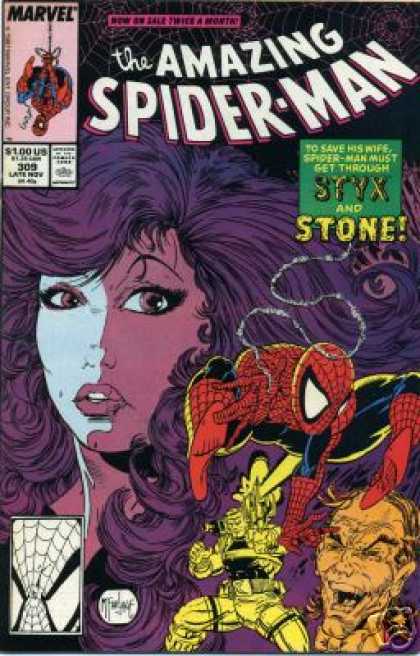
5. Spider-Man and Mary Jane Watson


Putting them on this list feels almost expected or gratuitous after all the hullabaloo on Teh Interweb about One More Day and the cheap, magical dissolution of their marriage. Keep in mind, I'm not writing this out of anger (and keep in mind that link right there was Pre-Steph case, so I was a trifle cynical) - I'm writing this out of love. I really do love this couple when they're written correctly, without laziness or cheese. Whereas the Powers That Be at Marvel see only a staid, limiting marriage, a lot of people, myself included, see the strong, healthy relationship they grew up with. Hell, before I ever went on a date, I'd read years and years of "relationship education" in the form of watching Peter Parker woo Mary Jane Watson - which turned out to be a little bit of a mixed blessing but that's a story for another time. Still, the point is that their relationship was an undeniably major influence in how I came to see and understand the very concept of love.


Sounds cheesy, right? I know. I'm almost embarrassed to admit it. It helps to know I'm not alone. The main reason I've loved them is that they're a couple I could understand completely, right from the ground up. Spider-Man is the mask that hides nerdy, insecure Peter Parker, right? We all know that. What most people don't get is that "Mary Jane, the model/actress" is the mask that hides the insecure, often unhappy Mary Jane, the person. They both wear masks and have done so constantly - for years. This was illustrated most poignantly in the briliant GN Spider-Man: Parallel Lives


Mary Jane is a fully-realized woman with her own issues who loves Peter, not in spite of either of their issues but because of them. They suit each other on deeper levels than most people realize. So, if you want to piss me off real quick like and alienate people from this relationship? Reduce her to being nothing but Spider-Man's "Prize" at the end of the day instead of the woman who loves and supports him and - this is crucial - vice versa. Be lazy and write her like a vapid supermodel, instead of the deep, pained woman who sees how hard the life Peter and her share together really is, then chooses to smile and champion him anyways. Par example -


VS


Now, it's okay to have Peter be thankful for having her in his life; in fact, I'd resent it if he wasn't grateful. Still, there's a difference in being thankful for a partner and taking her for granted. Lazily writing MJ as just "the hostage", "the wife" or worse is what some writers have been guilty of for years . . . which I think has lead to the wrongheadedness of One More Day but again, I digress. The point I'm trying to make is that they are thankful for one another and that they should be.


I'd even go so far to say that these two are a trifle codependent but it works for them. One needs the other to stand up to their tallest, to feel their best about life. Peter feels stronger because he can come home to the unwavering support of Mary Jane. Mary Jane feels better about herself because she knows that she makes him feel that way. Every life he saves is half hers and I think that's beautiful. They married one another without pretext or games, knowing full well what it would entail. I'd even go so far as to say that if you're not showing MJ as being as brave or as noble as Peter himself, you're not doing your job.


You know what my favorite thing about Spider-Man Loves Mary Jane is? You might think that it's that Mary Jane is the central (fully-clothed) character, not Spider-Man, and that's fair. No, what I love the most about the series is the cover of that first issue, telling you everything you need to know about these characters. Mary Jane is choosing to love Spider-Man. He may be the one with the powers but she's making the choice to love him. He's trusting her not to let him fall and they're both loving every minute of it.


The one thing I learned about love from the Spidey/MJ marriage growing up was that love wasn't a condition. Seeing these two struggle and support each other taught the naive, younger me that love wasn't a passive, storybook state of being. Love is a choice you have to make every day - something you fight for and maintain like a garden. Sometimes it's a damned hard choice to make but you make it. They call it "making love" for a reason - it's two people putting themselves out there in all their unashamed glory to make something beautiful happen. And if you're doing it right, making love takes a lot of sweat, passion, tenderness and time.


While I do wish they'd show MJ and Spidey sharing these sorts of sentiments when MJ's in something other than lingerie, I suppose it makes sense for Peter to only be able to share his most intimate feelings when he's at his most vulnerable. That and I guess they assume fanboys won't listen to tender moments if she's not half-naked. *sigh* Still, that's not the point. The point is that they're a healthy, happy couple - or were at least, until Joey Q. and company decided that showing a real, adult relationship in comic book form was too much work.


This is the first comic book couple I ever loved and it bothers me that they aren't together any more. Sure, there's still other places I can enjoy Peter and MJ (and I do love the hell out of Ultimate Mary Jane and Peter, mind you) but it's not the same as the marriage I grew up with.


Really, I could post a hundred snapshots of why I love these two but I'll stop here. If anybody needs me, I'll be taking my own advice about waiting out One More Day until people realize just how wonderful this relationship was and bring it back.


BONUS VIDEO CONTENT!

The Iconic Upside-Down Kiss!


Live Action Spider-Wedding!


Animated Spider-Wedding!